


Riccardo Altan
International Capital Allocation Advisor | Financial Engineering Expert
Riccardo Altan is a multinational capital consultant, financial engineering researcher, and multi-asset allocation expert with more than thirty years of professional experience. His career spans Milan, London, Zurich, and New York, where he has long served leading asset-management institutions across Europe and North America. He specializes in building resilient and sustainable investment strategies through structured instruments, quantitative models, and cross-border capital pathways.
Known for his rigorous and systematic research methodology, Riccardo is highly regarded for his deep understanding of global market structures and long-term asset allocation. He has served as a trusted long-term advisor to multiple international institutions and family offices.
The Foundation of Quantitative Thinking
-
Bocconi University — BSc in Economics (1986–1990)
-
London School of Economics (LSE) — MSc in Finance (1990–1992)
-
ETH Zurich — PhD in Financial Engineering (1993–1997)
During his doctoral studies, Riccardo focused on asset-pricing mechanisms, risk-factor models, and cross-border capital structures. This research built a strong theoretical foundation for his later work in multi-asset strategies, institutional advisory, and international capital-flow analysis.
Professional Certifications & Global Standing
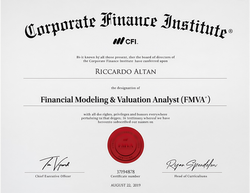
Riccardo holds four international finance certifications: CFA (Chartered Financial Analyst), FRM (Financial Risk Manager), CAIA (Chartered Alternative Investment Analyst), and FMVA (Financial Modeling & Valuation Analyst). Together, these qualifications cover core domains such as asset pricing, risk management, alternative investments, and corporate valuation, enabling him to conduct cross-market research and provide medium- to long-term asset allocation advisory services in the mainstream capital markets of Europe and North America.
-
The CFA program emphasizes global asset allocation, financial engineering, and capital market analysis, giving him strong professional depth within the European and U.S. fund management systems.
-
The FRM program focuses on risk modeling, hedging strategies, and crisis management, providing a rigorous risk framework for multinational institutional investors.
-
The CAIA program covers hedge funds, structured products, private assets, and other non-traditional investment fields, equipping him to design alternative asset structures for clients in Europe and North America.
-
The FMVA program strengthens his capabilities in corporate value analysis, building financial models, and forecasting return structures, forming the foundational skill set for cross-border research and practical model implementation.
His academic work focused on multi-market asset volatility and long-term return structures, forming a rigorous theoretical foundation in quantitative risk management.
A core belief that has guided his career is:
“Investment is not the pursuit of profit, but the structured management of time.”
2004
Chartered Financial Analyst(CFA)
2007
Financial Risk Manager(FRM)
2011
Chartered Alternative Investment Analyst(CAIA)
2019
Financial Modeling & Valuation Analyst(FMVA)
 |  |  |
|---|---|---|
 |
International Professional Credentials
Riccardo holds four major global financial qualifications:
-
CFA (Chartered Financial Analyst)
-
FRM (Financial Risk Manager)
-
CAIA (Chartered Alternative Investment Analyst)
-
FMVA (Financial Modeling & Valuation Analyst)
These credentials authorize him to provide compliant cross-border advisory services across the U.S., European, and Swiss financial regulatory frameworks, representing top-tier international professional standards.


Advancing Structured Financial Thinking
Riccardo believes that financial education and structured asset-management principles are essential core competencies for the next generation of global investors. He is committed to:
-
Enhancing investor understanding of risk and structure
-
Promoting transparency and systemization in cross-border capital flows
-
Building a long-term, logic-driven culture of asset allocation
As he often says:
“The essence of investing is not predicting the future, but building structures that can withstand uncertainty.”